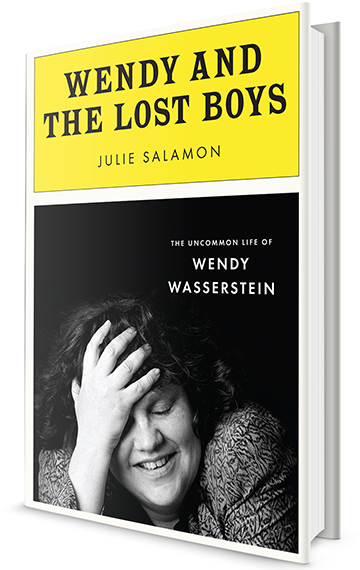
Wendy and the Lost Boys

On August 22, 2011, Penguin Press  published Wendy and the Lost Boys, the first biography of Wendy Wasserstein, the Pulitzer Prize winning playwright who came to represent the Baby Boom generation.

In “Wendy and the Lost Boys,” Julie Salamon’s shrewd, gripping biography, the gap between the public rendition of a live and how it was actually lived is shown at times to be startlingly wide…her fresh reporting (some 300 people were interviewed, and the book was written with cooperation from key menmbers of the Wasserstein family) gives the book a live, romping air.” –Emma Brockes,  The New York Times

“The author’s  real interest, however—and where the book excels—is in elucidating Wasserstein’s complex personality and the creative, unconventional life she fashioned for herself, balancing fraught but committed family ties with a busy social life teeming with devoted friends…Perceptive and empathetic, but also gently unsparing–a superbly nuanced portrait.”  Kirkus Reviews (starred review)


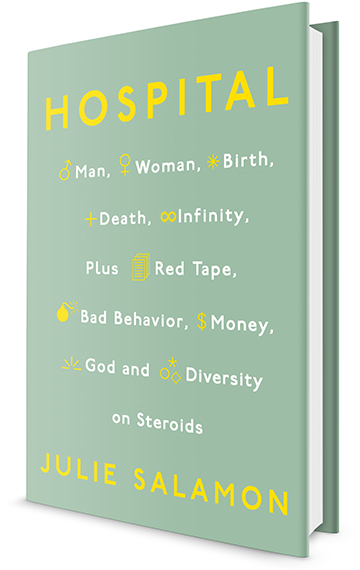
Hospital

“[In this] remarkable portrait… Salamon succeeds in providing a completely unique, three-dimensional and compellingly human perspective of the demanding work—both frustrating and rewarding that is not always apparent to hospital patients and their families.”Publishers Weekly (starred review).

“The fine grain of Ms Salamon’s observations allows her to paint a compelling—and damning—portrait of a dysfunctional health-care system… Its careful documentation of financial crises, feuds, personality clashes and, most of all, life-and-death drama it feeds the same appetite for pathos, intrigue, tragedy and redemption…as the current plethora of medical programs.”
— Economist

“I’ve never had much interest in hospitals (or been able to sit through an episode of ‘ER’), but as Salamon expertly sucked me into the saga of Maimonides, I realized this was about more than white coats, scalpels and beeping consoles. This place was 21st century America in a microcosm.”—Laura Miller, Salon

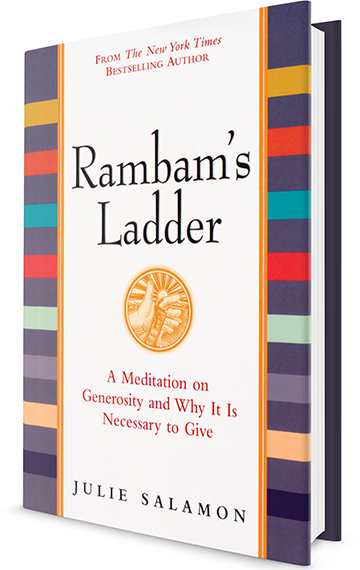
Rambam’s Ladder

Ohioana Book Award 2005

An exploration of the contemporary world of giving, via the wisdom of an ancient scholar. Elie Wiesel, winner of the Nobel Prize for Peace, called the book “a much-needed guide for anyone who believes in the noble precept that to give is to share.”

“The audience for this book is, basically, everyone. We can all benefit from its prod to examine how and why we volunteer, make charitable donations, help in times of crisis, give handouts to the “deserving” and/or the “undeserving.”—Philanthropy News Digest

“This is an extraordinarily graceful book about a sometimes awkward subject.”
—Ron Rosenbaum, author of Explaining Hitler

The Christmas Tree

New York Times bestseller, Audie Award/ Best Inspirational Book 1997

The story of an orphan girl who befriends a tiny fir tree that becomes the most famous tree of all, the tree at Rockefeller Center in New York City. “A rich, heartrending tale,” wrote Maureen Corrigan, NPR’s book critic, in Newsday. “I can imagine Dickens himself sniffling and smiling.”

“The touching tale of a girl and her tree, narrated by a Rockefeller Center gardener, will be a classic.” — Chicago Tribune

“Unusual and endearing…”—The Atlanta Journal-Constitution

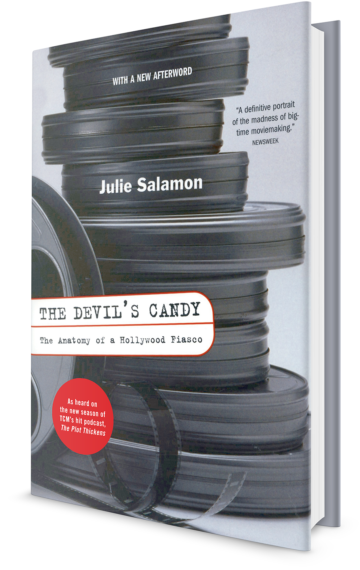
The Devil’s Candy

New York Times Notable Book 1991 and international best seller

This insider’s look at the movie business, said Newsweek, is “as close to the definitive portrait of the madness of big-time moviemaking as we’re likely to get.”  Legendary film critic Pauline Kael called it “the best book yet on how a big studio can shape the content of a movie.”

“The question of why good people make bad movies has never been answered more persuasively than in this book.” —Entertainment Weekly

“The most talked-about book in town.” —The New York Times

“A great story has found its meticulous teller…Ms. Salamon conveys with energy and tenacity the characters and emotions that shape the progress of a film-production juggernaut, and gives us one of the few panoptic accounts we have of a demanding and dangerously collaborative art.”” —The New Yorker

“Delightful…Salamon is the perfect reporter…she has the novelist’s gift.”” —Vogue

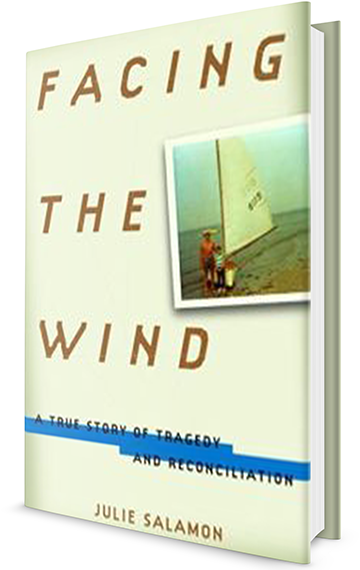
Facing the Wind

New York Times Notable Book, an NPR Fresh Air Best Book of 2001, a Los Angeles Times Best Book of 2001, Ohioana Book Award 2003, national best seller

“The story of an ordinary family dragged by fatal imperfection into a world of crushing disappointment, failure, and ultimately, violence,” said Erik Larson, author of  Devil in the White City. “A compelling narrative, yes. But, more important, you’ll never again take for granted the simple joys of everyday life, that most fragile state of normality and grace. It’s one of those all-too-rare books that haunt the soul long after the last paragraph is read.”

Facing the Wind…elevates itself out of the true crime genre into literature.” —USA Today

Facing the Wind raises profound questions: of guilt, retribution, justice, redemption and absolution. There are no easy answers. It is not a book that can be read and forgotten.” —The New York Times Book Review

“[Julie Salamon’s] book is important not only for its lessons on the ravages of mental illness but for its ability to overturn our assumptions about evil, innocence, guilt and compassion.” —The Wall Street Journal

“What is right? What is good? What is fair? I can’t remember when I last read a book that tackled these questions as unflinchingly as Facing the Wind. It moved me, astonished me, gave me nightmares, made me hug my children, and, long after I had (tremblingly) closed the covers, kept me thinking and thinking and thinking.” —Anne Fadiman, author of The Spirit Catches You and You Fall Down

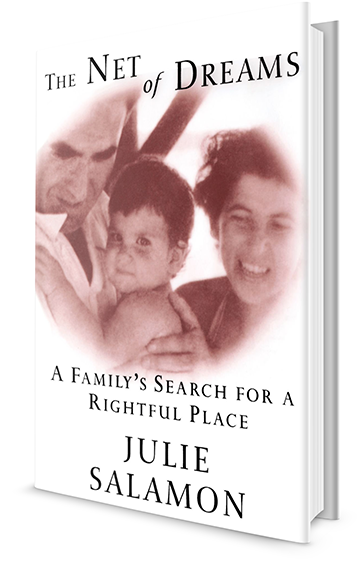
The Net of Dreams

New York Times Notable Book and winner of Ohioana Book Award 1997

Called  “a haunting journey of discovery” by Joan Micklin Silver, director of Hester Street. This memoir begins on the set of Schindler’s List, travels through the Carpathian mountains, Auschwitz., Prague, and New York, and ends, surprisingly, in a tiny southern Ohio town.

“…Salamon’s struggle for memory is an evocative theme. Her distinctly American book, The Net of Dreams, is a family memoir, but the family it speaks to should be vast.” —David Remnick, editor of the New Yorker

“This moving, intimate and often funny memoir demonstrates how the stories we must make up to survive can bring us to the actual truth, after all.” —Salon

“Salamon offers an excellent account of seeing the Holocaust through her parents’ experiences, perceptively illustrating how it affected her own life.” —Library Journal

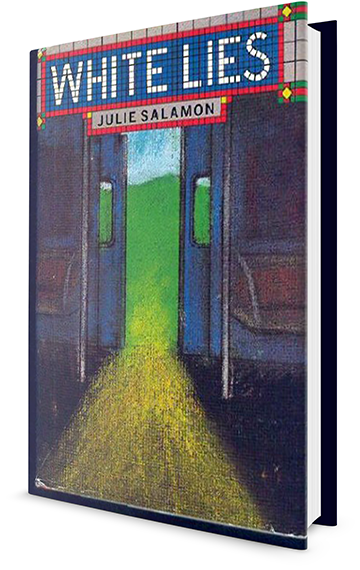
White Lies

“A bright, restless novel,” said Richard Yates of Salamon’s first book, the story of a young woman wrestling with the darkness in her family’s past.

“The best parts make your hair stand up; that’s enough.” —Kirkus Reviews

“The portrayals of Jamaica’s Czechoslovak parents, her feisty mother and silent doctor father, and of the beauty and dangers of rural America are evocative and vivid.” —The New York Times Book Review

ALSO BY JULIE SALAMON

  • Hospital
  • Rambam's Ladder
  • The Christmas Tree
  • The Devil's Candy
  • Facing the Wind
  • The Net of Dreams
  • White Lies